
This post is part of an ongoing series examining Ken Dark’s three recent books on Nazareth archaeology (2020 – 2023). The series focuses specifically on the archaeologist’s claims about the first century CE, especially his argument that a dwelling “from the time of Jesus” existed at the Sisters of Nazareth site. Topics include kokhim, Galilean chronology, rolling stones, and superposition.
An expanded and fully footnoted version of this critique can be found on Academia.edu.
This post is part of a series examining Ken Dark’s recent claims about first‑century Nazareth.
The focus: his argument for a dwelling “from the time of Jesus” at the Sisters of Nazareth site — and the archaeological and chronological issues involved.
Key topics include kokhim, Galilean chronology, rolling stones, and superposition. A formal academic version can be found on Academia.edu.
Cutting into “wall tumble”
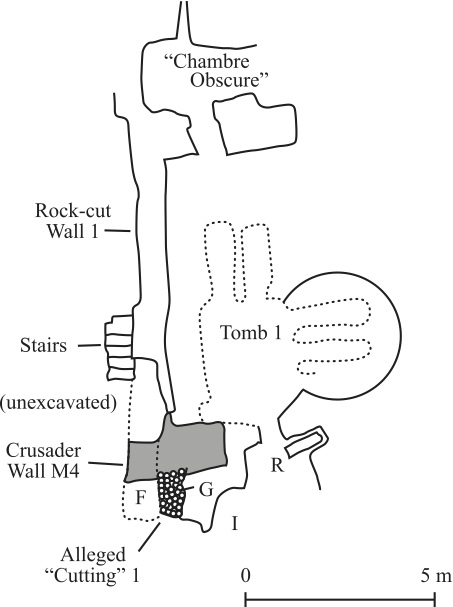
Illus. 4. The southern half of the Sisters of Nazareth Convent site (= NG Fig. 6.3). Key: Solid line = above ground features. Dotted lines of Tomb 1 = underground features. Dotted lines at left and F = alleged extensions of Wall 1 to the south. G = wall tumble. I = “infill” (actually a solid rock wall). R = round blocking stone. (Drawn by RS.)
In the preceding post, however, I noted that a point of contact between tomb and alleged dwelling does not occur – a solid rock wall intervenes (NG 98). In NazarethGate I further noted that Dark envisages a “cutting” not into a solid wall (as a cutting requires) but into what he describes as “wall tumble” (elsewhere as “rubble”):
There are yet further problems with this critical locus to the west of Tomb 1. In contrast to Dark’s claim that the tomb “cuts into” the above ground structure at F, a careful reading of his prose reveals no “cutting” there at all: the alleged tomb extension does not directly impinge upon the above ground wall extension at F but into “wall tumble” at G (Fig. 6.3; cf. Dark 2010:11). This further complicates Dark’s thesis, for not only is it unclear that the “tumble” is from the claimed wall F, but—even if it were—a cutting of the alleged tomb extension into wall tumble is hardly useful for positing that the tomb cut into the above ground structure. The tumble is not identical to the wall next to it, and hence no “cutting” is in fact demonstrated. To be minimally diagnostic, the cutting must be at F, not G.
One further complication is noted… [T]he alleged tomb forecourt is separated from the wall tumble by two meters of “infill” (I), a word which appears to be Dark’s euphemism for the solid rock separating the dromos from locus G. (NG 98)
So here we have Dark calling several meters of solid rock “infill” and claiming that, beyond that solid rock, an alleged “extension” of Tomb 1’s forecourt “cut into” above-ground “wall tumble.” Examination of the plans and photos (some prepared/taken by Dark himself) shows the foregoing scenario to be impossible or, at least, mysterious. Let us put aside the “infill” difficulty and focus on the “wall tumble.” What would the cut marks look like? And if the tumble was once loose, then (by definition) how could it be cut into? In fact, it is not clear that the wall tumble itself ever existed at this locus. The photo Dark provides shows an unevenly-worked low wall with sloping sides (2012:Fig. 12). This is what a workman would typically hew for an agricultural installation, taking little care to fashion perfectly vertical sides. In other words, the existence of “wall tumble” (much less a domestic wall) at this locus is itself questionable. Furthermore, on Dark’s plans from 2021 the wall tumble at G extends an entire meter, further divorcing it from the critical wall. In a subsequent post we will see that Dark develops the alleged wall tumble into a theory that “quarrying activity” took place at the SoN site. But for now we simply note that the point of contact between Tomb 1 and the alleged wall in the vicinity of M4 is – for multiple reasons – untenable.
The unattested “Tomb 3”
Perhaps responding to my 2015 critique voiced in NazarethGate, in his recent books Dark has developed a new theory that I consider astounding: that the “cutting” came not from Tomb 1 at all but from an unattested “Tomb 3” to the west of the site:
[a] The second of these new stretches of rock cut wall extends on the same alignment to the south of the main western line of Wall 1 and was cut by what seems to be the forecourt cut for another tomb (Tomb 3) to the west of Tomb 1. (Dark 2021:62.)
[b] That the possible tomb forecourt (Tomb 3) to the west of Tomb 1 cuts the rock-cut wall and rubble in that area suggests a similar sequence there. (Dark 2021:64; cf. pp. 67, 108.)
The problem here is that no evidence of a “Tomb 3” exists. In vain one looks for it on plans or charts of the site. Bagatti, Senes, Livio, etc. did not note, describe, or suspect such a tomb “to the west of Tomb 1.” How could they? For the alleged Tomb 3 lies entirely in unexcavated terrain. (See “Courtyard” in Illus. 2; compare Illus. 1 and “unexcavated” in Illus. 4 above.)
Other arguments (that I suspect are unknown to Dark) exist to render an additional forecourt (of “Tomb 3”) unlikely. Two forecourts (of Tomb 3 and Tomb 1) would not have been hewn side-by-side – a single entryway saved labor while fostering the sanctity and security of the tomb. If an additional tomb chamber did exist to the west of Tomb 1, it would in all likelihood have been connected underground to the neighboring chamber — even as Tomb 2 is connected to Tomb 1 at the SoN site. This was typical of multi-chamber kokh tombs.
It appears that the sudden appearance of Tomb 3 in Dark’s recent books is to preserve the concept of a cutting (by the principle of superposition) in the vicinity of M4. After all, my writing put the possibility of such a cutting from the eastern side (Tomb 1) into doubt. In addition, the archaeologist seems unsure whether the alleged cutting was into the wall at M4 or into adjacent rubble (see citation [b] above). Perhaps sensing this, Dark identifies the rubble as “wall tumble” and explicitly links it to the rock-hewn Wall 1 (which does exist and was associated with agricultural activity in post-Roman times):
Given that rubble recorded to the southeast of Wall 1 probably represents wall tumble from the southernmost continuation of that wall and, if so, must have come from that wall before it was truncated by the cut to its southeast… (Dark 2021:65)
Here the cutting is from the “southeast” – a reversion to the Tomb 1 thesis, only three pages after Dark suggested the cutting came from the west (citation [a] above). But we shall leave Dark with his various uncertainties and pass on to other things, for without evidence of a dwelling, without evidence of of a Tomb 3, with “rubble” (or “wall tumble”) and a solid rock wall (“infill”) intervening, no reason exists to further investigate the parameters of what appears to be an entirely hypothetical “point of contact.”
The conclusion of this particular investigation is clear: Dark’s dwelling → tomb sequence fails. Even were one to grant that a dwelling existed at the SoN site (which I disproved in my 2015 book), Dark has given us no reason to date that alleged dwelling to I CE or to the turn of the era. In other words: there was no demonstrable house from the time of Jesus.