
This post is part of an ongoing series examining Ken Dark’s three recent books on Nazareth archaeology (2020 – 2023). The series focuses specifically on the archaeologist’s claims about the first century CE, especially his argument that a dwelling “from the time of Jesus” existed at the Sisters of Nazareth site. Topics include kokhim, Galilean chronology, rolling stones, and superposition.
An expanded and fully footnoted version of this critique can be found on Academia.edu.
This post is part of a series examining Ken Dark’s recent claims about first‑century Nazareth.
The focus: his argument for a dwelling “from the time of Jesus” at the Sisters of Nazareth site — and the archaeological and chronological issues involved.
Key topics include kokhim, Galilean chronology, rolling stones, and superposition. A formal academic version can be found on Academia.edu.
Note: My apologies in advance for the great length of this post, required because Dark makes multiple errors regarding the size, date, and geography of “rolling stones.” If it’s any consolation, after reading this post you will be something of an expert on tomb “blocking stones” of Palestine during Early Roman times.
In the preceding post we reviewed two of Dark’s attempts to date a dwelling at the SoN site to “the time of Jesus.” Both arguments are false: (1) Kfar Hananya pottery as well as (2) limestone vessels continued (contra Dark) to be used long after the time of Jesus. Perhaps realizing the weakness of these arguments, Dark has developed a further argument to date the alleged dwelling to the time of Jesus: the rolling stone. We recall that a rolling stone, also called a “round blocking stone,” is at the entrance to Tomb 1 at the SoN site (illustration here). As early as 2012 the archaeologist made the following untenable claims:
[1a] Hachlili’s dating of the use of loculi [kokhim] to after the first century BC, and [b] the use of a rolling stone to seal a burial of this type to no later than the end of the first century AD, argue that [c] Tomb 1 may be dated typologically to the first century AD. (Dark 2012:58, with reference divisions added.)
It is true that Rachel Hachlili dated kokhim tombs to “after the first century BC”—but that was in Jerusalem! I pointed out in both my books that kokh tombs began to appear in the Galilee a full two centuries after they arrived in Jerusalem (MoN 162, NG 86). As for part [b] of the above citation, it is simply false, as we read in the following passage by an Israeli specialist:
[2] In later periods [i.e. after the turn of the era] the situation changed, and round blocking stones became much more common. Dozens of them have been found from the late Roman to Byzantine period… (A. Kloner 1999:25; discussion at NG 92 f.)
In other words, Dark’s view is unsustainable—rolling stones sealed kokhim tombs long after the first century CE, both in Jerusalem and elsewhere. And thus the archaeologist’s entire chain of reasoning fails, for he claims (a) that if the rolling stone dated before ca. 100 CE, then (b) so did the tombs at the SoN site, and (c) if the tombs so dated, then the dwelling (“Structure 1”) must have also—for (according to Dark) the dwelling preceded the tombs (as we discussed here):
[3] Given that Tomb 1 is a kokhim tomb, typologically dating to the first century AD (see below), then Structure 1 must date from the first century AD or earlier. (Dark 2012:51; cf. MoN 84–85, NG 99.)
In his recent books, the archaeologist is more precise and dates the dwelling to the alleged time of Jesus, i.e., “between the end of the first century BC and the first century AD”:
[4a] Of special typological interest concerning the Galilean tombs is Hachlili’s (2005) dating of the use of loculi to after the first century BC, with which Kloner and Zelinger (2007, 219) agree, [b] and her dating of the use of a large disc-shaped rolling stone to seal kokhim tombs to between the end of the first century BC and the first century AD (Hachlili 2005, 64). [c] Thus, any kokhim tomb with an entrance closed by a large rolling stone is typologically likely to belong to the period between the late first century BC and the end of the first century AD. (Dark 2020:97. Emphasis added and passage subdivided for discussion.)
Let’s take a closer look at this problematic passage, in which all three parts are incorrect. In [4a] Dark conflates Jerusalem and Galilean chronologies—something Hachlili never intended. Her book (Jewish Funerary Customs, Practices and Rites in the Second Temple Period) has nothing to do either with Galilean tombs or with tombs after 70 CE (Hachlili 2005:xxxi; NG 89–90). As a result, the second and third parts [4b, 4c] are also incorrect, for Hachlili writes that large rolling stones ended in the Jerusalem area ca. 70 CE—but Dark erroneously extrapolates this chronology to the Galilee. In fact (as Hachlili and other specialists would readily agree) a few post-70 CE tombs with large rolling stones have certainly been found outside Jerusalem (e.g. at Khirbet Midras, Horbat ‘Ethri, and Khirbet Shema), and many more tombs with only average-size rolling stones have also.
We conclude, then, that Dark’s terminus ante quem of ca. 100 CE for kokhim tombs (and for rolling stones) did not exist in history. That false terminus, however, is vital to Dark’s argument—for it allows him to date the alleged dwelling to “the time of Jesus.”
Small vs. large rolling stones?
The real nub of Dark’s untenable arguments regarding rolling stones has to do with their size. In support of his vital terminus ante quem of “ca. 100 AD,” the archaeologist has developed another false argument: large rolling stones ended ca. 100 CE, at which time they gave way to a smaller variety:
[5] [A]ny kokhim tomb with an entrance closed by a large rolling stone is typologically likely to belong to the period between the late first century BC and the end of the first century AD… Kloner and Zissu (2007) also agree that although rolling stones were used after c. AD 100, the stones were much smaller than those before that date. (Dark 2020:97, emphases added.)
Dark has misunderstood the literature, as we shall soon see. No change in the size of rolling stones occurred ca. 100 CE. As mentioned above, a few tombs with exceptionally large rolling stones continued to be hewn in Palestine after 100 CE. Dark, however, has more than merely overlooked those tombs. Before continuing, let’s review typical rolling stone sizes. The literature gives the following approximations:
Smaller rolling stone diameter size: 0.8–1.0 m. (2.6–3.3 ft.)
Average rolling stone diameter size: 1.0–1.2 m. (3.3–4.0 ft.)
Larger rolling stone diameter size: 1.2–1.8 m. (4–6 ft.)
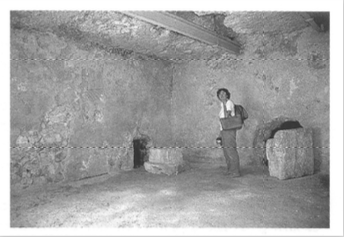
Illus. 5. Two tomb chamber entryways with square blocking stones of the “plug” type. Note the low height of the entryway in front of the woman.
In post-70 times most kokhim tombs had rolling stones of average diameter (1.0–1.2 m), the occasional exception being larger or smaller. The data reveal no ca. 100 CE change in the size of entryways or in the size of blocking stones from larger to smaller.
Having put that misconception to rest, we turn to a further egregious misunderstanding of Prof. Dark: that the rolling stone at the SoN convent site is of the “large” variety. In fact, the stone is 1.09 m (3.6 ft.) in diameter (Dark 2021:121). Despite the imposing impression given by photographs in general circulation (illus. here), this diameter—as we have seen—is typical. However, Dark characterizes the rolling stone at the SoN site as “large”:
[6] A key chronological indicator is the use of a large rolling stone (0.8 m or over in diameter) to seal the entrance of the tomb [at the SoN site]. (Dark 2021:121)
Dark’s parenthesis “0.8 m or over in diameter” shows how mistaken he is—an 0.8 m (2.6 ft.) diameter rolling stone was not large but very small. Dark repeats the error in another passage:
[7] In Galilee, where they apparently have no associations with tombs of exceptional status at all, tombs sealed by large (0.8 m or over) circular rolling stones seem to have been especially common. (Dark 2020:97)
Actually, virtually all rolling stones were larger than 0.8 m in diameter. Dark then multiplies the error by claiming that “large” rolling stones came to an end ca. 100 CE:
[8] Although smaller rolling stones continued in use into the Byzantine period, [“large”] stones of the size attested here [i.e. at the SoN convent site] were no longer used after c. AD 100… (Dark 2021:121)
This is all wrong, as we have seen. The rolling stone at the SoN site was not large but quite average, and there is no evidence of a decrease in size ca. 100 CE. Nevertheless, these errors allow Dark to date the Nazareth rolling stone (and thus the associated SoN tomb complex) to I CE:
[9] Hachlili (2005) and Kloner and Zissu (2007) also agree that although rolling stones were used after c. AD 100, the stones were much smaller than those before that date. Consequently, a tomb sealed by a rolling stone of c. 0.8 m or more in diameter can confidently be assigned to between the late first BC and the late first century AD, and probably more specifically to the mid- to late first century AD. (Dark 2020:97)
In fact, Hachlili, as well as Kloner and Zissu, wrote nothing of rolling stones in II CE and beyond — both of the cited books deal specifically with Second Temple–period tombs (2nd c. BCE–1st c. CE).
The probable origin of Dark’s error regarding rolling stones
Very little has been written about rolling stone sizes, which leads me to suspect that Dark’s misunderstanding comes from a passage (cited below) in a 1999 Biblical Archaeology Review article authored by Amos Kloner. The author makes a rather arcane distinction between round blocking stones that moved to the side into a hewn receptacle (“rolling stones”) and small, round blocking stones that simply leaned against the entryway. Perhaps because of the confusion that could attend “round” vs. “rolling,” Kloner always uses the designation “round blocking stone” (which includes both types), even at the risk of rendering his English (which is not his native language) cumbersome. In the article he noted that the “blocking stone” that closed a tomb came in a variety of forms—not always round. Firstly, the blocking stone could be square (the majority of later blocking stones) or round in shape. Secondly (and this is what apparently escaped Dark) is that the round blocking stone could (a) “lean against the rock facade” (BAR p. 28) or (b) be “set on one end between two parallel walls and thus moved on a sort of track” so that it “could easily be rolled away” (p. 25). Most people casually call the latter type “rolling stone,” but we must bear in mind the distinction that Kloner signals: all round blocking stones are not automatically “rolling stones.” Some round blocking stones simply leaned against the entrance of the tomb. According to Kloner, these “leaning stones” (my euphemism) came to preponderate in Late Roman and Byzantine times — and they were typically smaller than the earlier round stone that rolled away (what we call the “rolling stone”)—generally less than 0.9 m (3 ft.) in diameter, which is small enough for one or two people to maneuver aside and not requiring either a track or the hewing of a recess to one side.
Let us review: tomb blocking stones came in a number of varieties. Square blocking stones leaned against the entryway or were furnished with a plug (Illus. 5). Round blocking stones (of the smaller variety) could lean against the entryway or (of the average and large varieties) could roll away. With the foregoing in mind, here is Kloner’s description of later round “leaning stones”:
(10) So far we have been talking about blocking stones from the Second Temple period, which ended with the Roman destruction of Jerusalem in 70 C.E. In later periods the situation changed, and round blocking stones [of the leaning variety—R.S.] became much more common. Dozens of them have been found from the late Roman to Byzantine periods (second to seventh century C.E.). These later round stones were much smaller than the Second Temple period stones (less than 3 feet in diameter), and they did not move on a track but simply leaned against the rock facade, making them even simpler to move. (A. Kloner, BAR 1999.5: pp. 25, 28.)
Kloner is explicit: the “later round stones were much smaller than the Second Temple period stones” and they “simply leaned against the rock facade.” Dark apparently misread the foregoing passage and assumed that “rolling stones” diminished in size after ca. 100 CE. They did not. The preferred mechanism of tomb closure changed from a rolling stone to a leaning stone ca. 70 CE (with a concomitant reduction in stone weight). However, the “rolling” stone type continued in use (see above), and the one at the SoN site in Nazareth is an example of very average size.
The foregoing explanation nullifies Dark’s argument that rolling stone sizes changed ca. 100 CE. His claim that the rolling stone of the SoN Tomb 1 is “large” is, in any case, groundless. In turn, his conclusions that the tombs at the SoN site dated before 100 CE and that a prior dwelling dated to the time of Jesus are untenable.