
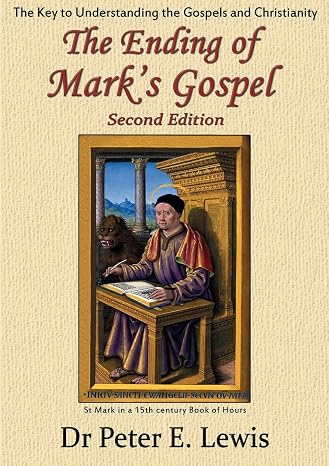
I recently received a thin book (128 pages) from an author in Australia, Dr. Peter E. Lewis, a retired surgeon now about eighty years old. The book is entitled The Ending of Mark’s Gospel: The Key to Understanding the Gospels and Christianity (Second Edition), Zeus Publications 2020. The book appears to be a print-on-demand from Ingram and is simply formatted with table of contents and no index. In this review I consider only the first fifty pages, which deal with Lewis’ intriguing theory regarding the abrupt beginning and ending to the Gospel of Mark. The author’s remaining pages I find less persuasive in that they are based on the standard views that the canonical Jesus was active in the time of the Herods, that Nazareth and Bethlehem existed at the turn of the era, that Mark’s gospel dates to the first century CE, and that the account in Acts of the Apostles is generally reliable (all which I reject).
In the Introduction the reader learns that, besides medical training, Dr. Lewis gained an honors degree in Divinity from London University and a post-graduate diploma in Theology (GDipTheol) from Brisbane College. He also has a long-standing interest in Roman coins, which is of relevance because one section of his book deals with the denarius in Mk 12:15. After retirement in 2002 he was vice-president of Hopewell Hospice on the Gold Coast. A theist who takes “what would be considered a mystical approach,” Lewis does not believe in the virgin birth and considers that “the form that Jesus might have taken after his resurrection is beyond human comprehension.” He adds: “I have always had a strong Christian faith… [but my] independent research would not have been possible if I was a priest or minister of religion.”
The beginning of Mark’s gospel
The main theme of Lewis’ book is that the outer leaf of a quire in an ancient codex of Mark’s gospel is missing. “As Mark’s gospel is the shortest gospel it could have been written on only one quire. Therefore, if the last page is missing, the first page would be missing too” (p.23). As a result, the beginning and ending of the gospel are (a) abrupt and (b) linked. Furthermore, Lewis considers that the removal of the leaf was deliberate:
The whole outer leaf of the gospel was deliberately removed, thus removing the beginning and end of the gospel. The likely reason was that the disciples were portrayed as stubbornly not believing that Jesus had risen and Mark had described Jesus’s birth as natural, which was unacceptable to the Gentile Christians in Rome. [p. 18]
Lewis describes the mechanism by which the outer leaf was removed:
Of all the papyrus fragments dated to before the 5th century there is only one of Mark. If the outer leaf was deliberately removed it must have been done at an early stage before many copies could be made. The person responsible probably did not act alone but belonged to a group of like-minded Gentile Christians. The matter must have been so important to them that any codices of Mark’s gospel that they had access to were similarly dealt with. This group were so thorough in their work that no manuscript with Mark’s original beginning exists. [pp. 33–34]
After the outer leaf was removed, a new beginning to the gospel would be required. Lewis maintains that the extant first sentence serves this purpose: “The beginning of the good news [euaggelion] about Jesus Christ, the Son of God.” This sentence reflects the orthodox (Catholic) theology of the Roman church. For the evangelist, however, “Jesus is declared to be the Son of God at his baptism (Mark 1.11)… [which] requires Jesus’s birth to be natural for Mark” (30–31). Lewis continues his argument by noting that if Mk 1:1 is viewed as a later addition, then the original “good news” of the gospel was not the coming of Jesus Christ at all—it was the coming of the kingdom of God (Mk 1:15; Lewis p. 25). Furthermore, “If the leaf was removed because Mark had described Jesus’s birth as natural, which the Gentile Christians in Rome could not accept, ‘Son of God’ in 1:1 indicates the purpose of their action” (p.26). The author writes:
It is the thesis of this paper that Mark had written about the parentage and birth of Jesus but this information was on the first page of his gospel, and when the outer leaf of the codex was pulled off the first and last pages were removed. [p. 28]
The ending of Mark’s gospel
Considerations regarding the ending of Mark’s gospel are more complex, because various endings are extant. Lewis writes:
Because the primary purpose might have been to remove the first page of Mark’s gospel, it is likely that the last page was kept by some in the group and later inserted as a loose leaf between the pages at the end of a codex or copied as an addendum into a subsequent codex. In this case the scribes would have been very suspicious of this extra text. They showed their hesitation to incorporate it into the gospel by putting asterisks, etc., around it. [p. 34]
Lewis concludes that if the loose leaf were inserted into a codex ending with “they reported” (shorter ending), then “this combination would result in manuscripts containing the shorter and the longer endings” (p. 35). However, the author “reconstructs” one clause between the first sentence in the shorter ending and Mk 16:9, a clause not found in any witnesses: “but they did not believe that Jesus had risen.” It is, of course, an important clause which “might be the key to understanding the original ending of Mark’s gospel” (39). Evoking the surgeon that he is, Lewis cuts and splices the ending of Mark: “If one removes the second sentence from the shorter ending,” he writes, “adds the missing verse [the above-discussed clause] that naturally follows, and deletes verses 16, 17, and 18, it becomes apparent that the original ending is a brief but carefully crafted conclusion to the gospel” (43). In my opinion—though Lewis’ argument is believable—because it rests on unattested evidence it must be considered provisional.
Conclusion
Lewis’ argument is worthy of attention. The deliberate removal of a codex leaf in antiquity is a theory probably too radical for most scholars, even today, which may explain why the theory has not (to my knowledge) been previously broached. As with so much that threatens Christian tradition, important work is now originating from the margins of the field, from non-academics, “independent scholars,” and former academics nearing or past retirement—as the late Father Thomas Brodie, who passed away in February of this year. (I consider Brodie’s work here.)
Lewis is alive to the internecine feuds among early Christians. He writes of a “pro-Peter” and “anti-Peter” faction, and considers that Mark’s gospel has an anti-Peter bias (38). His book implies textual tampering at a very early time. This is all salutary and reveals, once again, that caution and a good deal of suspicion are the best approaches when examining the received Christian tradition.
N. Clayton Croy made this argument in his 2003 book, “The Mutilation of Mark’s Gospel,” Abingdon Press. See my blog post a couple of weeks after yours: https://jesusreconstructed.com/2026/08/31/the-missing-ending-of-the-gospel-of-mark/