
This post is part of an ongoing series examining Ken Dark’s three recent books on Nazareth archaeology (2020 – 2023). The series focuses specifically on the archaeologist’s claims about the first century CE, especially his argument that a dwelling “from the time of Jesus” existed at the Sisters of Nazareth site. Topics include kokhim, Galilean chronology, rolling stones, and superposition.
An expanded and fully footnoted version of this critique can be found on Academia.edu.
This post is part of a series examining Ken Dark’s recent claims about first‑century Nazareth.
The focus: his argument for a dwelling “from the time of Jesus” at the Sisters of Nazareth site — and the archaeological and chronological issues involved.
Key topics include kokhim, Galilean chronology, rolling stones, and superposition. A formal academic version can be found on Academia.edu.
Was a “courtyard house” at the Sisters of Nazareth site?
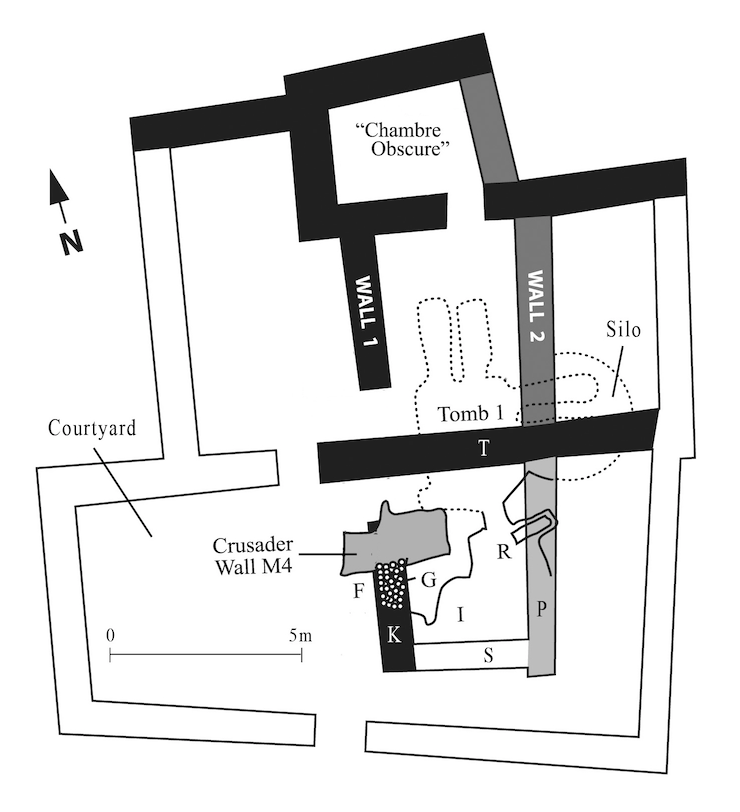
Illus. 3. Dark’s conception of the ‘model courtyard house.’ Underground features are in dotted lines. (Redrawn from Dark 2012: Figs. 5,15,16. Cf. NG Fig. 6.6.)
One can, then, parallel the location, plan and artefactual assemblage of Structure 1 with other excavated Early Roman-period domestic buildings from the Galilee. There is a specific structural analogy between Structure 1 and the classic ‘courtyard house’ of the same period. (Dark 2012:17)
In order to date the dwelling to the Early Roman Period (the “artefactual assemblage of Structure 1”), on the same page Dark notes a spindle whorl found “in the earliest soil layer” and some “Early Roman-period Kefar Hananya-type cooking-pot body-sherds.” These are cases of misrepresentation. The spindle whorl was actually found in a museum box with many unlabeled items (NG 81–82). Hence it is unprovenanced and could have come from anywhere. As for the Kfar Hananya “body-sherds,” such ware continued to be produced into the fifth century CE (NG 82).
Dark bases the form of the alleged dwelling on the work of Y. Hirschfeld, who notes that the courtyard house was primarily an urban form belonging to wealthy families:
The “courtyard house” is more characteristic of private construction in the cities. Most courtyard houses in the country were of a traditional type: a house with an inner courtyard, simple, and without columns. These were relatively spacious houses (with an area of at least 200–300 m2) belonging to wealthy urban families. Some elaborate courtyard houses were also found in the agricultural areas of the country – presumably the estate houses of wealthy landowners. They may be considered the local version of the villa in the Roman architectural tradition. (Hirschfeld 1995:102)
In my 2015 book I questioned that a Galilean village would have such a structure: “This does not sound at all like the dwelling of poor villagers in an out-of-the-way hamlet—as the tradition is wont to describe the first century settlement of Nazareth” (NG 112). More importantly, however, the structural remains at the SoN site do not match either Dark or Hirschfeld’s conception of the model courtyard house:
The greatest problem with [Dark’s] interpretation is that many of the requisite walls for such a house do not exist. Fig. 6.6 (above) [ = Illus. 3 at right] is based on Dark’s reconstruction of the house. The features in black are walls which the archeologist claims are “certainly partially or wholly present.” Those in medium gray “may be reasonably inferred,” while the southern wall in light gray “would have been destroyed by the construction of Tomb 1’s forecourt” (AJ:54). Yet, we have seen that such an extensive forecourt is problematic if not entirely hypothetical. Furthermore, of all these walls (in black, dark, or light gray), only the rock-cut Wall 1 is represented in the material remains. The result is that the “rectilinear room” (between Walls 1 and 2) – the central feature of Dark’s alleged model courtyard house – is especially poorly evidenced and is not even a “room.” Its western rock-cut wall is hardly suited to a domestic structure, while the eastern Wall 2 is probably a Crusader-era construction and thus chronologically problematic. In addition, the southern wall of the “room” is not manifest for 80% of its alleged length. (NG 108)
In sum, the evidence that Dark claims for a dwelling does not exist. The conclusion of my 2015 analysis was unequivocal: “The end result of this discussion is that one must question the entire applicability of Dark’s ‘model courtyard house’ to the Sisters of Nazareth site” (NG 112).
My 2015 analysis appears to have had an affect on the British archaeologist, for in his recent books Dark surprisingly admits a far more modest possibility – that the dwelling might have only been a “quarryworker’s hut”:
The exact plan and character of the Phase 1 domestic use is uncertain. Depending on whether one favours model 1 or model 2, it might be understood as a courtyard house with a side courtyard to its west or a simple quarryworker’s hut. (2021:125; cf. 2021:111 & 114.)
Thus, Dark’s recent books present two possibilities: “model 1” and “model 2,” the latter corresponding to a quarryworker’s hut. One cannot help suspecting that the second possibility was admitted because the archaeologist experienced so much difficulty supporting the first. He admits what is obvious from a cursory review of the physical remains: that Structure 1 comprises “a series of rock-cut walls” (2021:65). Dark terms this “new evidence” – which is a curiosity, for I pointed out the rock-cut features in NazarethGate (p. 109) and noted how poorly they fit a wealthy courtyard house. Furthermore, in his recent books Dark satisfies the rock-cut nature of the features by proposing that the alleged dwelling was in a cave. This astonishing pivot virtually eliminates the “model courtyard house” from consideration and may explain why Dark’s recent books emphasize the “quarryworker’s hut” option:
However, at the exact point chosen for Structure 1 there had been a natural cave in the rock, which was incorporated into the design of the rock-cut walls very cleverly, with its west side being reworked to become a series of steps leading to a level at which part of the cave roof had been retained as an overhang projecting eastwards… [T]he north wall of Structure 1 was another part of this same cave… (2021:54)
The “cave dwelling” interpretation is yet another unusual aspect of Dark’s interpretation of the site. We must now add it to other anomalies that have preceded. Just as one thing leads to another, the untenable view that a dwelling once stood above Roman tombs has led to the extremity of Dark’s currently published position: that a “quarryworker’s hut” (alternatively: a “courtyard house”) once stood above tombs and in a cave. And let us not forget: this constitutes Dark’s principal claim for a settlement in the Nazareth basin at “the time of Jesus.”
Reduced to the foregoing strange scenario, Dark writes in his 2021 book that “there is evidence of the very poor in ancient Israel using caves as homes… More specifically, caves continued to be used for domestic and other purposes in Nazareth into the late twentieth century” (2021:106). The archaeologist even scoured the streets of Nazareth for examples and found a humble dwelling with rock-cut walls close to the SoN convent (2020: Pl.6).
In another post we will see that the “quarryworker’s hut” idea is related to another of Dark’s recent innovations: that a phase of quarrying activity took place in mid-I CE, between the time the house was inhabited and the time the tombs began to be hewn (2021:120). These new ideas seem to be the products of desperation. In my opinion Dark attempts to salvage what was a fundamentally flawed conception from the start. He even links the quarrying activity at the SoN site (and around ancient Nazareth) to the biblical account that the father of Jesus was a tekton (Mk 6:3), a word the archaeologist glosses as “a general craftsman, perhaps specifically one associated with building” (2021:203). This link may appeal to Christian fundamentalists but it does nothing to make his arguments more archaeologically sound.
By 2020 Dark had been visiting the SoN site for fifteen years. Though he has received no permit to excavate, he knows the surface features intimately. I find it astonishing that, after so much time, the archaeologist’s final assessment is an uncertain choice between vastly different conceptions: a quarryworker’s hut vs. a model courtyard house. A hut is a poorly constructed, single room dwelling (how it would be in a “cave” is a curiosity that we shall leave aside), while a courtyard house is a well-constructed, multi-room structure cum courtyard. Dark’s abiding ambivalence is analogous to an auto mechanic who, after repeatedly examining a vehicle, cannot even say whether he is looking at a motorcycle or a truck.