
This post is part of an ongoing series examining Ken Dark’s three recent books on Nazareth archaeology (2020 – 2023). The series focuses specifically on the archaeologist’s claims about the first century CE, especially his argument that a dwelling “from the time of Jesus” existed at the Sisters of Nazareth site. Topics include kokhim, Galilean chronology, rolling stones, and superposition.
An expanded and fully footnoted version of this critique can be found on Academia.edu.
This post is part of a series examining Ken Dark’s recent claims about first‑century Nazareth.
The focus: his argument for a dwelling “from the time of Jesus” at the Sisters of Nazareth site — and the archaeological and chronological issues involved.
Key topics include kokhim, Galilean chronology, rolling stones, and superposition. A formal academic version can be found on Academia.edu.
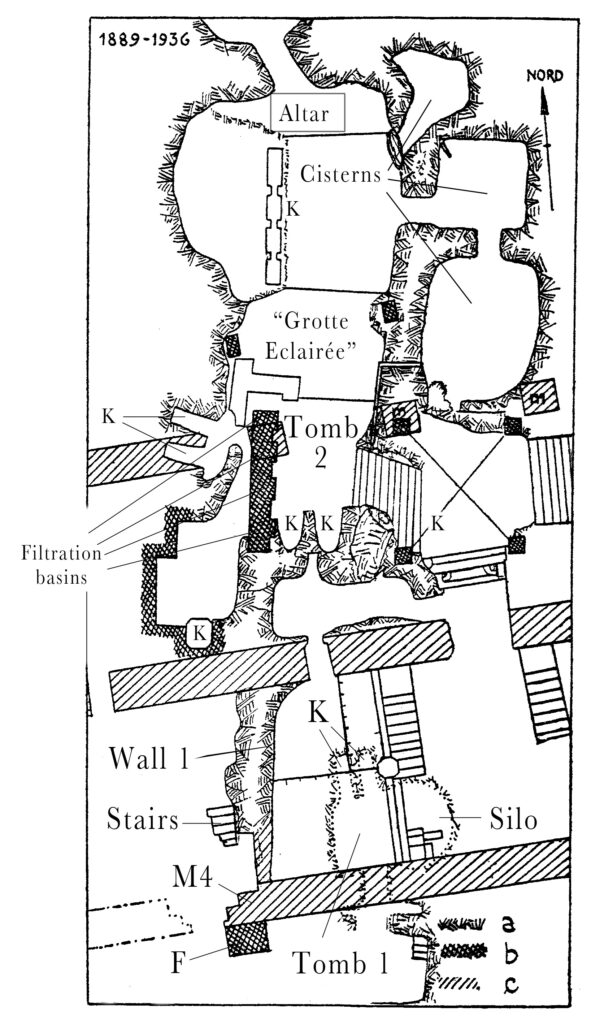
Illus. 1. The Sisters of Nazareth “cellar” according to a mid‑19th‑century plan, showing kokhim (burial niches, “K”) and the two tomb chambers (Tomb 1, Tomb 2). The silo to the south, filtration basins, and cisterns to the north are later intrusive agricultural and communal installations. Wall 1, rough and rock‑cut, is one of the major walls in Dark’s proposed “courtyard house.” M4 (lower left) is the critical junction where Dark claims Tomb 1’s forecourt “cut into” an alleged above‑ground dwelling — his key argument for dating the supposed dwelling earlier than the tomb. However, this is impossible, for a solid rock wall intervenes (NazarethGate 98).
Dark proposes that a dwelling ‘from the time of Jesus’ once stood directly above Tomb 1 (2021:Ch.9) – but not at the same time. He is aware that (for reasons of ritual purity) Jews would not live above tombs, and so he proposes that the dwelling was abandoned shortly before the tombs were hewn in mid-I CE. Thus, in Dark’s view, a dwelling stood at the SoN site ‘in the time of Jesus’ but was abandoned not long afterwards and just before the tombs were hewn (2012:7,12,15; 2021:108).
Dark terms the dwelling ‘Structure 1’ (there is no ‘Structure 2’) and the chronological time of its habitation ‘Phase 1.’ The subsequent period of tomb use he initially termed ‘Phase 2,’ but (perhaps due to difficulties that I raised in my 2015 book, NazarethGate) he has recently introduced a short period of ‘quarrying activity’ in the middle of I CE. He now calls the quarrying ‘Phase 2a’ and the subsequent use of the tombs ‘Phase 2b’ (2021:108,113).
Dark’s super-crowded chronology and shifting phases
Thus, in his three recent Nazareth books Dark proposes a busy sequence of activities all taking place in the first century CE:
• habitation of a dwelling ‘in the time of Jesus’
• abandonment of that dwelling towards mid-I CE
• a short quarrying phase around mid-I CE
• hewing of the tombs around mid-I CE
• abandonment of the tombs before ca. 100 CE
This amount of activity – all in the first century CE – is astonishing and, to my knowledge, has never been proposed for any other site in ancient Palestine. Dark’s scenario also contains at least one impossibility: that the tombs under the SoN site were abandoned within a half-century of being hewn! In one passage he even writes: “the tomb was presumably never used for burial” (2021:221). This is (to be blunt) absurd. Besides representing a colossal waste of energy, the archaeologist has apparently forgotten that earlier investigators discovered skeletons and bones in situ (2021:12,21,76,123,129,210).
In upcoming posts we will see that Dark’s complex sequence of phases appears to have one goal: to demonstrate that the alleged dwelling dated to the turn of the era. The mechanics required include untenable claims – for example: (i) a ca. 100 CE terminus ante quem for kokhim tomb use; (ii) a ‘cutting’ of the underground tomb into the above-ground dwelling (to prove that the dwelling was first); and (iii) a locus outside both structures where that cutting ostensibly took place. Already in my 2015 book I critiqued these points. In his recent books Dark has pivoted – he now proposes that the cutting was into ‘rubble’ and that a short period of quarrying activity took place in mid-I CE. He has also proposed a hypothetical ‘Tomb 3’ (apparently Dark’s invention) that produced the cutting from another direction. The latter claim appears to be pure invention, however, for the alleged ‘Tomb 3’ is in completely unexcavated terrain.
I showed in NazarethGate that many features Dark assigns to ‘Structure 1’ (the alleged dwelling) also do not exist in the physical remains (NG 107 ff). As for the features that do exist, many are rough-hewn from solid rock and are hardly compatible with the “model courtyard house” that Dark proposes for the dwelling. Perhaps in response, Dark has pivoted again: he now proposes that the ‘courtyard house’ may have been a modest ‘quarryworker’s hut’ (2021:114)!
The agenda behind the interpretation
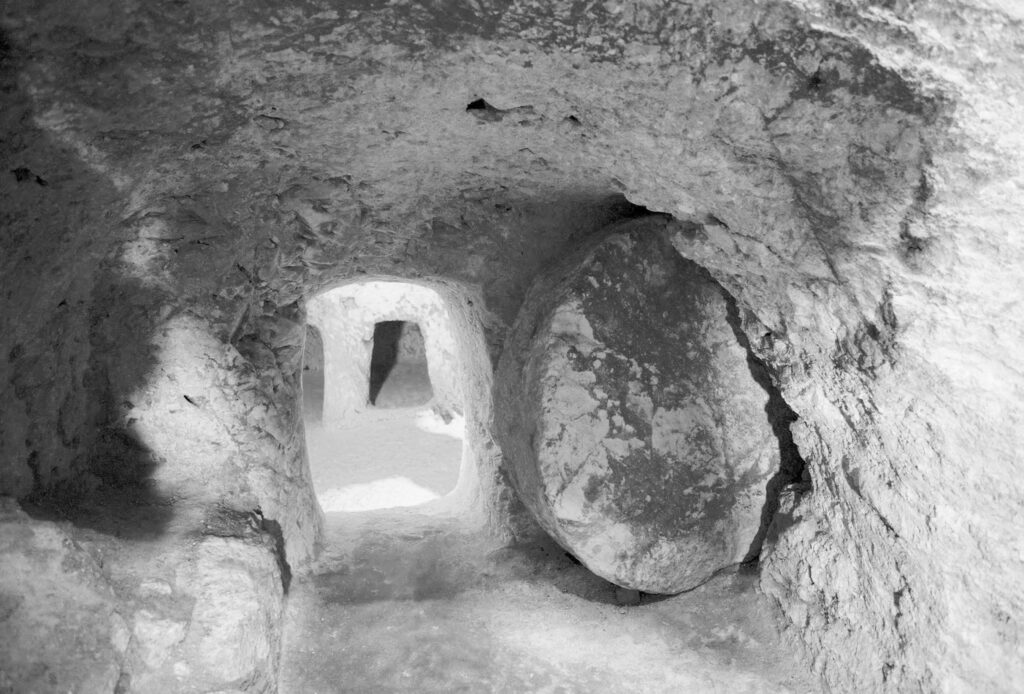
Illus. 2.The entryway (dromos) of Tomb 1, with rolling stone in the foreground and two kokhim visible in the background. In the photo the stone may appear deceptively large. It is of average size (109 cm / 3.6 ft. in diameter) and the entryway is about three feet high. A person had to crouch (or crawl) to enter or leave the tomb.
• the proposal that a dwelling once stood over a tomb site,
• a hyperactive I CE chronology,
• a hypothetical Tomb 3,
• the proposal that the SoN tombs were unused or abandoned within half a century of being hewn,
• the ambivalence whether the dwelling was a ‘model courtyard house’ or a ‘quarryworker’s hut.’
These curiosities (and impossibilities) attest that Dark’s interpretation of the site is contrived and not the result of physical evidence at all.
The apparent agenda is as old as Nazareth archaeology itself: to find a house ‘from the time of Jesus.’ The devout Sisters of Nazareth have long cherished the notion that a saint – at minimum – was buried under their premises. They also supposed that a Roman-era dwelling once stood there (2021:24 & Ch. 6). The fundamental conflict between burial and dwelling simply did not occur to them, for until the mid-20th century it was not widely appreciated in Christian circles that Jews do not live in the vicinity of tombs. In fact, this ignorance has greatly aided my researches, for older Nazareth accounts (and plans such as Illus. 1 above) identified many burials under Christian holy sites (including under the Church of the Annunciation!) that have been assiduously ignored in recent generations (MoN 254). After the Second World War, however, when Jewish purity regulations became better appreciated, a tomb’s presence suddenly meant that no dwelling existed nearby. This understanding has posed a ghastly threat to the traditional siting of the entire settlement (which is in the middle of a hillside cemetery – MoN 219 ff) and to the streams of pilgrims who visit the ‘Venerated Area’ every year.
In the next post we will look more closely at Dark’s contradictory conceptions of the ‘house from the time of Jesus.’