
This post is part of an ongoing series examining Ken Dark’s three recent books on Nazareth archaeology (2020 – 2023). The series focuses specifically on the archaeologist’s claims about the first century CE, especially his argument that a dwelling “from the time of Jesus” existed at the Sisters of Nazareth site. Topics include kokhim, Galilean chronology, rolling stones, and superposition.
An expanded and fully footnoted version of this critique can be found on Academia.edu.
This post is part of a series examining Ken Dark’s recent claims about first‑century Nazareth.
The focus: his argument for a dwelling “from the time of Jesus” at the Sisters of Nazareth site — and the archaeological and chronological issues involved.
Key topics include kokhim, Galilean chronology, rolling stones, and superposition. A formal academic version can be found on Academia.edu.
A note: The purpose of this series is to confront head-on what I regard as a deeply misguided and increasingly influential archaeological narrative promoted by Prof. Ken Dark regarding the Sisters of Nazareth (SoN) Convent site. The SoN site augurs to become a touchstone in discussions of early Nazareth, despite my extensive 2015 take-down of Dark’s reconstruction in NazarethGate Chp. 6. My aim here is to place a clear, durable critique of Dark’s three recent books into the record – a speed bump, so to speak, to slow down the horde of Christian fundamentalists so eager to embrace the least archaeological “evidence” that the gospel narrative is true.
Though Dark’s claim that a domestic structure once stood at the SoN site is gaining traction among lay people and non‑specialists in New Testament studies, the Israeli archaeological community largely remains silent. To me, this discrepancy speaks volumes: archaeological claims related to Early Christianity are being accepted in confessional forums without the rigorous evidentiary scrutiny they demand. To date, no one else has stepped forward to challenge the empirical bankruptcy so evident to me in the field of Early Christian Archaeology. This contrasts with the field of Old Testament Archaeology where, now for over a generation, strong voices have provided alternatives to the standard literary paradigm (Finkelstein, Thompson, Davies, Gmirkin, to mention a few). It is time that New Testament Archaeology also came under review – and extensive revision.
The “Jesus‑era” dwelling: a claim built on interpretive scaffolding, not evidence
Dark is the first archaeologist to argue that a Roman‑period dwelling existed at the SoN site. This is a striking claim, because the site contains rock‑cut tombs from the same period — features that normally preclude habitation. Other archaeologists have recognized the tombs but have not identified a dwelling. Dark argues that earlier investigators misunderstood the site, asserting that crucial relationships among features were “overlooked” (2023:109, 111). He even titles a chapter “Setting the record straight.”
But the record is hardly straightened by his reconstruction. The material remains, as published, do not support the domestic structure Dark envisions, nor several of the architectural relationships he infers. He proposes a Tomb 3, an extension of the forecourt of Tomb 1, and a point of contact between the tomb complex and the alleged dwelling. These are the load‑bearing pillars of his argument and, as I shall argue, none of these exist in the physical remains.
The problem of ritual purity
Any reconstruction that places a dwelling beside active tombs must confront Jewish purity law, which prohibited living in close proximity to tombs (Mishna b. Bathra 6.8). Dark addresses this by proposing that the dwelling predates the tombs. This avoids the more problematic alternatives: (a) that the dwelling was occupied while the tombs were in use, or (b) that the dwelling was built over a ritually impure area.
Dark cites scholars who argue that burial in or near a disused domestic structure was not prohibited (2012:19; 2021:116). This may be true, but the scenario is so unusual that the rabbis probably did not even think of it.
The sequence of occupation: a reconstruction without physical contact
To establish the chronology of a house “from the time of Jesus,” Dark must show that the dwelling predates the tombs. But the SoN site presents two major obstacles:
• No rigorous stratigraphy was conducted, and
• No datable movable finds (pottery, etc) were found in situ.
(The movable finds in the SoN museum are not diagnostic: many are unlabeled and some are known to have come from other sites.)
This leaves the so-called principle of superposition as the major tool remaining to establish relative chronology. According to this principle, when two structural features meet, the feature doing the cutting, intruding, or impinging is younger than the feature being cut into. For example, if a pipe cuts through a wall, the pipe is newer than the wall. Archaeologists often use the principle of superposition to determine which structure came first. But superposition requires physical contact between features. And here lies the central problem: the alleged dwelling and the tomb complex do not meet. The tomb is below ground; the proposed dwelling is above ground. Without a point of contact, superposition cannot be applied. This is not a technical quibble. It is central flaw in Dark’s entire SoN conception, for without a point of contact there is no way to establish chronological sequence, and without chronological sequence there is no dwelling “from the time of Jesus.”
Dark attempts to create the vital point of contact through two untenable proposals:
1. an extension of Tomb 1’s forecourt, and
2. a hypothetical Tomb 3 located in unexcavated terrain west of the site.
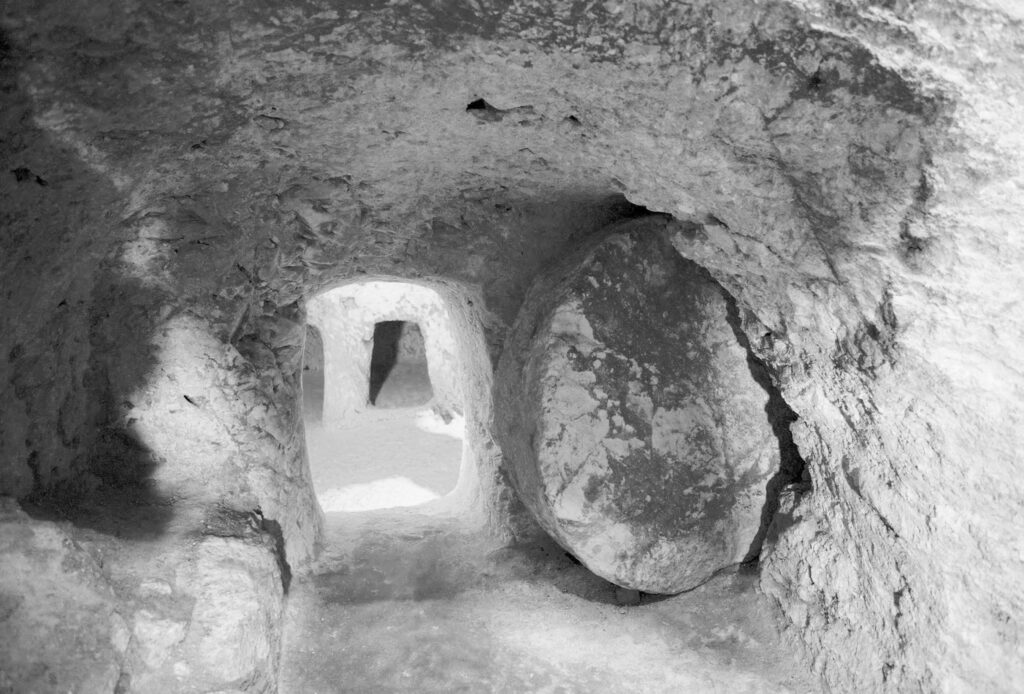
Illus. 3. The entryway (dromos) of Tomb 1, with rolling stone in foreground and two kokhim visible in the background. Note the solid limestone wall to the left ( = west), preventing any extension of the forecourt in that direction, as Dark claims.
The proposed extension of Tomb 1’s forecourt
Dark expends enormous effort considering the locus M4 (Illus. 1, scroll down) as the vital point of contact between dwelling and tomb. Already in his 2012 Antiquaries Journal article (p. 58) he suggested that the forecourt of Tomb 1 extended westward to meet a wall of the alleged dwelling at M4 (Illus. 2). However, the published photograph above shows a solid rock wall on the west side of the forecourt – an immovable geological fact that precludes such an extension, as I noted in my 2015 book (NG 98, 111). In his three recent books Dark no longer insists on this proposed extension but now suggests that the relevant cutting may derive from an unexcavated structure he terms “Tomb 3,” located west of the known tombs. This apparently invented structure has not been excavated or documented in the published record, yet it is a pivotal element in Dark’s revised reconstruction, and I consider it closely in the next post.