
This post is part of an ongoing series examining Ken Dark’s three recent books on Nazareth archaeology (2020 – 2023). The series focuses specifically on the archaeologist’s claims about the first century CE, especially his argument that a dwelling “from the time of Jesus” existed at the Sisters of Nazareth site. Topics include kokhim, Galilean chronology, rolling stones, and superposition.
An expanded and fully footnoted version of this critique can be found on Academia.edu.
This post is part of a series examining Ken Dark’s recent claims about first‑century Nazareth.
The focus: his argument for a dwelling “from the time of Jesus” at the Sisters of Nazareth site — and the archaeological and chronological issues involved.
Key topics include kokhim, Galilean chronology, rolling stones, and superposition. A formal academic version can be found on Academia.edu.
The purpose of this series is to examine what I regard as significant problems in Prof. Ken Dark’s interpretation of the Sisters of Nazareth (SoN) Convent site. My aim is not primarily to entertain or to attract readers, but to document this critique in a semi‑permanent form so that future investigators can trace the interpretive issues surrounding the SoN site and the broader question of “the myth of Nazareth.”
Over the last twenty years, Dark has advanced a reconstruction – most recently in three books on Nazareth archaeology – arguing that a domestic structure once stood at the SoN site during the early Roman period (“the time of Jesus”). His interpretation has been influential among non‑specialists in New Testament studies, though it has not been widely adopted by Israeli archaeologists familiar with comparable sites. In my view, this situation reflects a broader tension within the field, in which archaeological claims outpace the empirical evidence available in the ground. Because no substantial critique of Dark’s reconstruction has yet been offered within the discipline (and is not likely in the foreseeable future), I present this series as a necessary contribution to that overdue discussion.
This critique was suggested to me a couple of months ago by Neil Godfrey over at Vridar (thanks, Neil). I had no idea at the time (March 2026) that it would grow into a mammoth 40-page article—but, then, in the last decade Ken Dark has produced no less than three books on Nazareth archaeology:

Dr. Ken Dark
• The Sisters of Nazareth Convent: A Roman-Period, Byzantine, and Crusader Site in Central Nazareth. Palestine Exploration Fund Annual XVI 2020. London: Routledge (hereafter: “Dark 2021”);
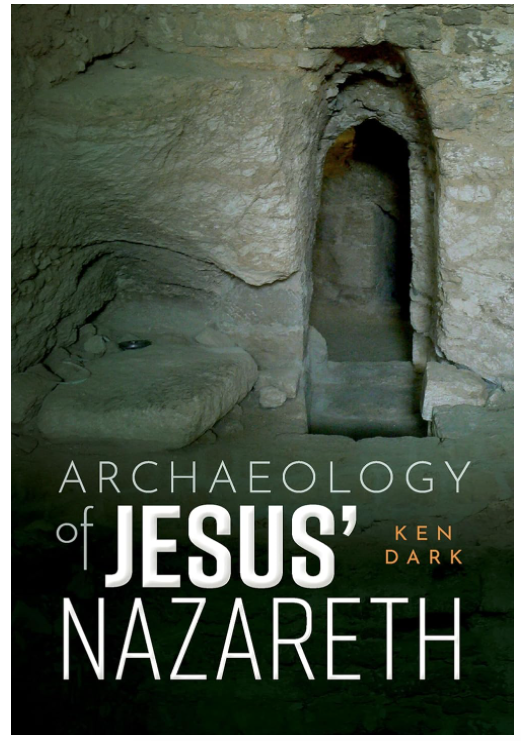
• Archaeology of Jesus’ Nazareth. London: Oxford Univ. Pr., 2023 (hereafter: “Dark 2023”).
I will be breaking this critique up into a series of posts and will be publishing them over the coming weeks. Let me say up front that this will not be a traditional ‘review’ of the three books. It is a critique specifically focussing on what Dark writes relative to the first century CE — ‘the time of Jesus’ — which is the time of greatest interest to readers of Mythicist Papers and also to society at large. The second book above, The Sisters of Nazareth Convent, is the most important in this respect. For readers new to this topic: the Sisters of Nazareth site is a complex of kokhim tombs — rock‑cut burial chambers typical of Jewish practice in Roman Palestine. That site has been Dark’s focus of attention for many years and is where the archaeologist claims to have discovered a house ‘from the time of Jesus.’ Upon that claim hang all of Dark’s speculations regarding a I CE settlement in the Nazareth basin, for without that alleged dwelling no hard evidence for such an Early Roman settlement remains. The reader may recall that I have already refuted a similar prior claim — that of Y. Alexandre at the neighboring International Marian Center (NazarethGate chp. 10) — it was not a house but a wine-making installation. The same can be said for an alleged dwelling (the house of Mary!) under the nearby Church of the Annunciation (for gosh sakes, it’s among tombs! – NG chp. 13), as well as bogus Hellenistic coins at Mary’s Well (NG chp. 11). I always seem to be spoiling the party.
 Thus, in the upcoming series of posts I will only tangentially consider the first and third books above. The first, Roman-Period and Byzantine Nazareth and its Hinterland, largely conveys the results of Dark’s surface surveys conducted in the lowland between present Nazareth and the Sepphoris hill to the north. Here Dark finds signs of difficult-to-date quarrying activities and evidence of farms in antiquity. To my knowledge, Dark has never held a permit to excavate anywhere in or around Nazareth (as opposed, for example, to Y. Alexandre), which necessarily limits his work to surface observations, architectural sketches, and secondary reports. This immediately puts Dark in a tricky category where he is filling books with many claims concerning places he has never actually dug. Perhaps this is one reason a lot of what Dark writes is, in my opinion, unfounded, speculative, and just possibly ‘imaginative.’
Though I consider the first two books above poorly referenced, they are intended for a scholarly readership, while the third book, The Archaeology of Jesus’ Nazareth, is a summation of Dark’s work directed at the general reader and is published by prestigious Oxford University Press. The amazon.com page writes that the book requires “no previous knowledge of biblical history or archaeology” — an astute assessment I consider spot-on. According to the website, the book describes “what are probably the ruins of a first-century house,” asking “whether the Sisters of Nazareth house really could have been the childhood home of Jesus.” But, as I said above, all this depends on the actual archaeological arguments presented in Dark’s second book, the one published in 2021.
This series of posts is an initial and more informal presentation of a more detailed and more rigorously footnoted article that I will subsequently upload to Academia.edu and perhaps other venues. It is a sequel to my 2015 chapter in NazarethGate, “A Critique of Dr. Ken Dark’s Writings Relative to the Sisters of Nazareth Convent Site.”
So in this series I’ll focus on the claims that matter most — those touching the first century CE, the period Dark repeatedly frames as ‘the time of Jesus.’ That is where the archaeological stakes are highest, and where his arguments are most vulnerable. If Dark’s interpretation of the Sisters of Nazareth site collapses, then the entire case for a first‑century settlement at Nazareth loses its latest archaeological anchor.
Next →